
Blog
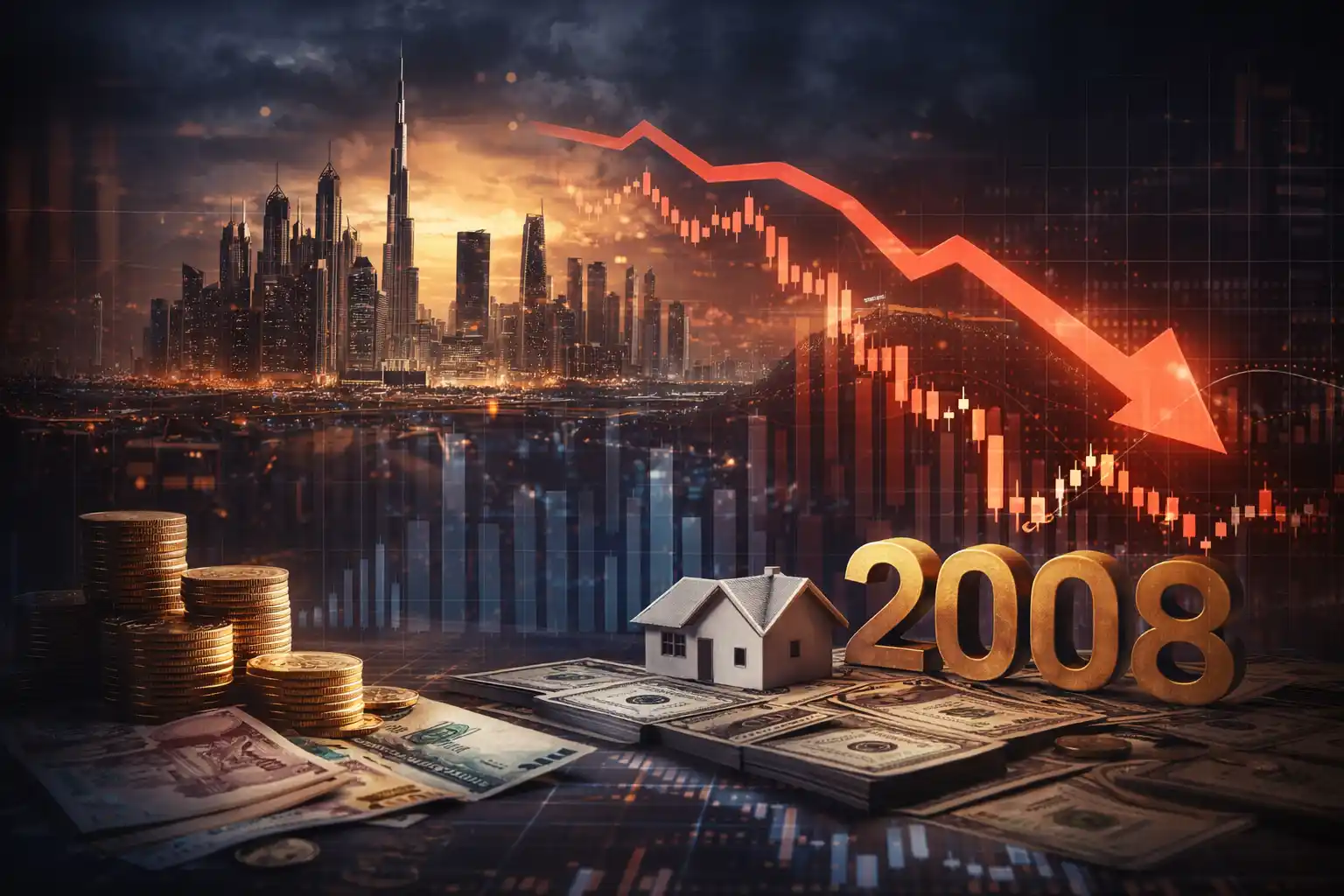
Deja Vu — Is the 2008 Real Estate Crisis Repeating? This Time, Dubai Sets the Tone.
History does not repeat mechanically. But it rhymes.
And when markets begin to sound familiar, experienced participants tend to become quieter.
In 2008, the crisis did not begin with collapse. It began with confidence. With the belief that prices could only move higher. With the assumption that liquidity was endless.
The market did not crash because people were afraid.
It crashed because, for too long, no one was.
Today, when we look at certain real estate markets — and particularly Dubai — that sense of déjà vu starts to emerge again.
Dubai as a thermometer, not an exception
Dubai has always been a different kind of market. Fast. Aggressive. Highly dependent on external capital.
It does not merely follow global trends — it often front-runs them.
After the pandemic, the city became a magnet for capital from Russia, Europe, Asia, and the crypto sector. Zero income tax, strong liquidity, aggressive development pipelines, and the perception of being a “safe haven” in an unstable world created powerful inflows.
The result?
Luxury property prices surged at a pace reminiscent of pre-crisis cycles. Off-plan sales became dominant. Leverage increased. New developments entered the market at a speed that implies one thing: confidence that demand will not slow.
We have seen this before.
How every real estate crisis begins
Real estate crises do not start with a lack of buyers.
They start with overconfidence.
When:
price appreciation is treated as guaranteed
construction outpaces organic demand
credit expands faster than income
investors buy for resale rather than use
the classic bubble mechanism begins to form.
In 2008, the catalyst was the U.S. mortgage market. Today, the conditions are different — but the behavioral dynamics are strikingly similar.
Why Dubai matters as a signal
Dubai is highly sensitive to global liquidity.
When money is cheap — it accelerates rapidly.
When liquidity tightens — it feels pressure early.
In a world where interest rates are no longer near zero and global liquidity moves in cycles, the question is not whether cooling will occur. The question is when — and how deep.
And when the most dynamic market begins to show signs of oversupply or speculative excess, more stable markets often follow with a lag.
The behavioral cycle matters more than the numbers
In 2008, very few believed that “prices could fall everywhere.”
Today, very few believe that “this could be similar.”
But crises do not require identical conditions. They require identical psychology.
And that psychology appears familiar:
FOMO in the luxury segment
speculation in pre-construction units
the belief that international capital will always offset local risk
This does not imply an imminent collapse tomorrow.
But it does suggest the accumulation of systemic tension.
What is different this time
There is, however, a meaningful difference.
Banks are more regulated.
Capital requirements are stronger.
The financial system is more cautious.
That reduces the probability of a global systemic meltdown similar to 2008.
But it does not eliminate the risk of regional or market-specific corrections.
And when corrections begin in a market like Dubai, the psychological impact often exceeds the economic one.
The connection to the broader financial system
Real estate has always been a mirror of liquidity.
When liquidity is abundant — property rises.
When liquidity tightens — stress becomes visible.
In a world marked by geopolitical tension, elevated interest rates, and capital rotation, property markets are more sensitive than they appear.
Deja vu does not mean repetition in a 1:1 format.
It means that cycles continue to operate under the same structural logic.
The question is not “if,” but “where first”
If cooling begins, it is unlikely to be uniform.
It will likely impact:
the most aggressive markets
the fastest-growing segments
the most leveraged structures
At this moment, Dubai fits that description.
Deja Vu is not a warning. It is a reminder.
A reminder that:
uninterrupted growth is fragile
confidence without risk management is dangerous
markets do not collapse when everyone expects them to — but when complacency sets in
2008 did not begin with panic. It began with indifference to risk.
And that is precisely what makes the current picture so compelling.