
Blog
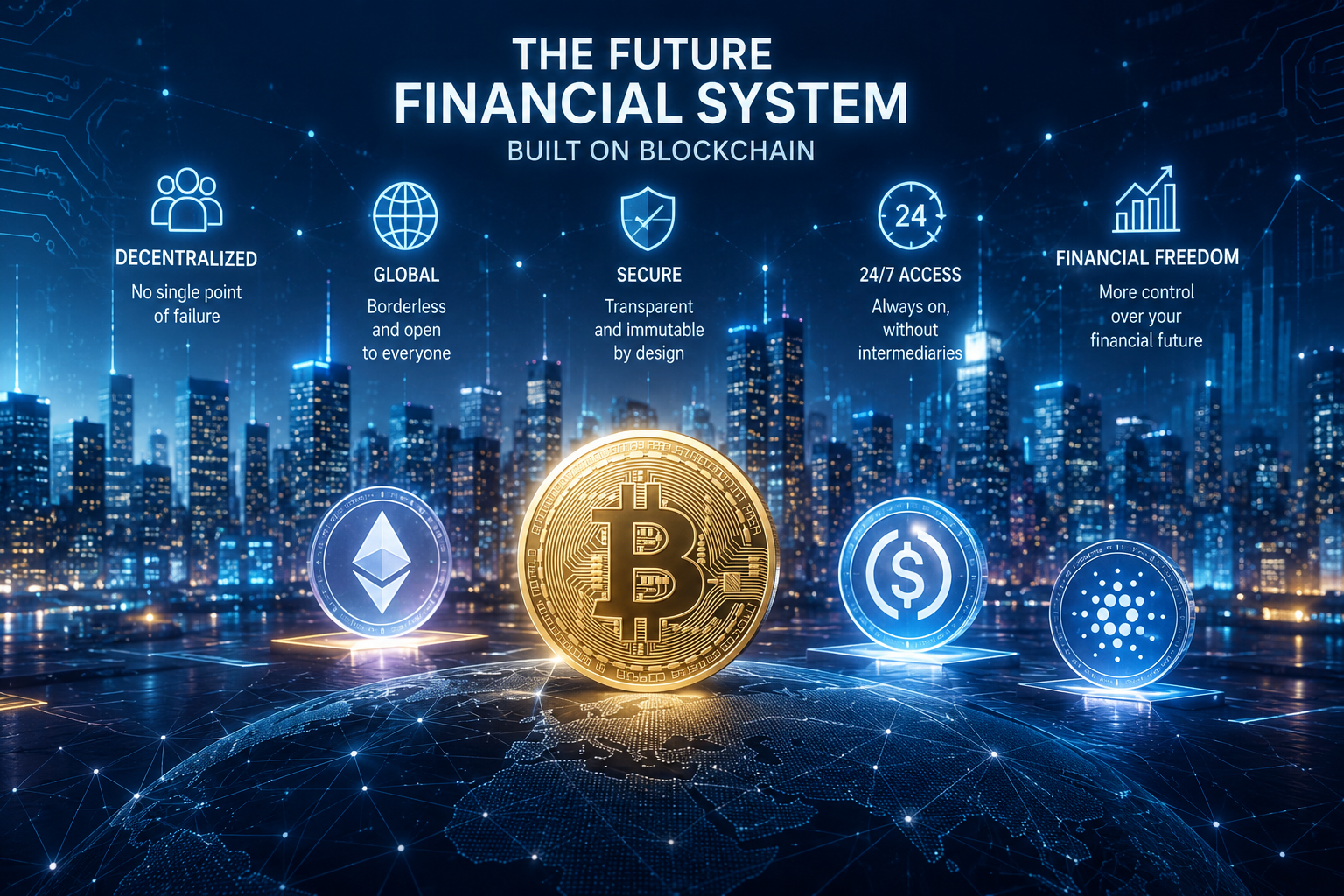
Here’s Why the Crypto Market Is the Future Financial System
Sometimes the biggest changes do not look obvious while they are happening.
At first, they look like an experiment.
Then like speculation.
Then like a bubble.
Then like a threat.
And eventually, like inevitability.
That is exactly what the crypto market looks like today.
For some, it is still just a place for quick profits, meme tokens, volatility, and risk. For others, it is a technological revolution. For others, it is a danger to the old financial order. But if we look deeper, the crypto market is much more than just another investment sector.
It is a new financial layer.
A layer that works globally.
A layer that never sleeps.
A layer that does not ask which country you are in.
A layer that allows value to move through the internet in a way the old system struggles to copy.
And that is exactly why it increasingly looks like the crypto market is not just part of the financial future.
It may become the future financial system itself.
The old system is slow, expensive, and dependent on intermediaries
Today’s financial system works, but it does not work equally well for everyone.
For large banks, institutions, and corporations, it is convenient. They have access to capital, liquidity, infrastructure, international payments, and financial instruments that the ordinary person often does not even see.
But for millions of people, the system is slow, expensive, and restricted.
International transfers can take days.
Fees can be absurdly high.
Access to banking services depends on country, documents, approval, and intermediaries.
And your money almost always has to pass through someone else’s gate.
Crypto changes that.
It allows value to be sent directly, globally, and almost instantly. Not because rules are unnecessary, but because the infrastructure is different. Instead of everything passing through a closed system of intermediaries, crypto networks create direct access to a financial layer.
That is a massive change.
Crypto works 24/7
Traditional markets have opening hours. Banks have working days. International transfers have delays. The financial system often looks modern on the surface, but behind the scenes, it is still built on old processes, old rails, and old limitations.
The crypto market works differently.
It is open 24 hours a day, 7 days a week.
No weekends.
No bank holidays.
No need to wait until Monday.
No need for an office to open.
This may seem like a small detail, but it is actually fundamental.
Because in the digital world, information moves instantly. Business is global. People work across borders. Capital seeks speed. And the old system often still moves at a pace that no longer matches reality.
The future financial system will not be able to afford to “close.”
Crypto already does not close.
Finance without borders
One of the strongest ideas behind the crypto market is that it is not limited by geography.
If you have an internet connection, you can participate.
You can create a wallet.
You can receive assets.
You can send value.
You can hold Bitcoin.
You can use stablecoins.
You can interact with DeFi protocols.
You can become part of a global network.
This is something the old system has never fully provided.
It always had gates.
It always had limitations.
It always had intermediaries deciding who can and cannot participate.
Crypto does not remove every problem, but it removes one of the biggest barriers: the need for permission to participate.
And when we talk about the future financial system, access is key.
Stablecoins are already showing what the future may look like
Many people think about crypto only through Bitcoin or speculative tokens. But one of the most important elements of the future financial system will likely be stablecoins.
Why?
Because they connect the old world and the new world.
On one side, they use a familiar unit of value — most often the dollar.
On the other side, they move through crypto infrastructure.
This means you can use digital dollar value without waiting for a traditional bank transfer. You can move value globally. You can pay, receive, store, and transfer liquidity much faster.
That is the bridge.
Not everyone will start directly with Bitcoin. Not everyone will use DeFi. Not everyone will understand complex protocols. But stablecoins are much easier to understand because they offer a familiar unit of value on top of a new technological foundation.
And that is how major changes often begin.
Not with full replacement.
But with a bridge.
DeFi shows what happens when financial services become open
Decentralized finance may be the strongest experiment in the crypto world.
For the first time, we are seeing financial services that do not require a traditional bank in order to exist.
Lending.
Liquidity.
Exchange.
Yield.
Tokenized assets.
Market infrastructure.
All of this can work through code, smart contracts, and open protocols.
Of course, DeFi still carries risks. There are hacks, bad projects, complexity, regulatory uncertainty, and many mistakes. But the idea is too big to ignore.
Because it shows something very important:
financial services can be programmed.
And when finance becomes programmable, the entire system changes.
Tokenization will bring the real world on-chain
The next major phase will likely not be only about cryptocurrencies.
It will be about tokenization.
Real estate.
Bonds.
Stocks.
Commodities.
Debt.
Funds.
Real-world assets.
All of this can gradually be represented digitally on blockchain infrastructure. That does not mean the real world disappears. It means ownership, trading, and settlement can become faster, more transparent, and more accessible.
Imagine an asset that can be traded globally, 24/7, with lower barriers and clearer traceability.
That is not a small optimization.
That is a new architecture.
And if a large part of real-world assets eventually becomes tokenized, then crypto rails will not be just an alternative.
They will become infrastructure.
Bitcoin is the digital foundation of independent money
When we talk about the future financial system, Bitcoin holds a special place.
Not because it is the fastest.
Not because it is the most flexible.
Not because it solves every problem.
But because it introduces the idea of independent digital money with limited supply.
In a world where governments can print money, debts keep growing, currencies lose purchasing power, and trust in institutions is weakening, Bitcoin offers a completely different logic.
No central office.
No CEO.
No central bank.
No possibility for someone to simply decide that tomorrow there will be twice as much Bitcoin.
That makes it important not only as an asset, but as an idea.
The idea that money can exist outside the political will of a single state.
Ethereum is the infrastructure for the new financial internet
If Bitcoin is the digital foundation of independent money, Ethereum is one of the main infrastructures for building a new financial internet.
Ethereum allows not only the storage of value, but also the creation of applications, protocols, tokens, financial instruments, and automated systems.
That is why so many DeFi, NFT, stablecoin, and tokenization experiments are connected to Ethereum or similar smart contract networks.
The future financial system will not be only about money.
It will be applications.
It will be automation.
It will be digital ownership.
It will be programmable liquidity.
It will be interaction between the real and digital worlds.
And that is exactly where smart contract platforms become extremely important.
The old world is already entering the new one
The biggest sign that crypto is not just a temporary trend is the fact that the old financial world no longer ignores it.
Banks, funds, payment companies, institutions, and even governments are studying blockchain, stablecoins, tokenization, and digital assets.
Not all of them like it.
Not all of them understand it.
Not all of them want to lose control.
But almost all of them now know they cannot simply ignore it.
That is an important moment.
Because first, the system laughs at a new technology.
Then it attacks it.
Then it regulates it.
Then it integrates it.
And crypto is already in that phase — not just being rejected, but being used, regulated, and gradually embedded into the larger financial system.
The new financial system will probably be hybrid
It is important not to think too extremely.
The future will probably not be a world where all banks disappear tomorrow. It will not be a world where everyone uses only Bitcoin. It will not be complete anarchy without rules.
More likely, the future financial system will be hybrid.
Part of it will be traditional.
Part of it will be regulated.
Part of it will be decentralized.
Part of it will be tokenized.
Part of it will use stablecoins.
Part of it will use blockchain behind the scenes without the user even noticing.
But the main change will be clear:
value will move faster, more globally, more transparently, and more programmably.
And that is exactly the direction crypto is already leading.
Crypto returns control to the people
One of the strongest arguments for crypto is control.
In the old system, you often do not fully own access to your own money. You have a bank balance. You have an account. You have an intermediary. You have rules that can change. You have limitations that may not depend on you.
Crypto introduces a different idea:
you can hold your assets yourself.
That brings responsibility, but it also brings freedom.
“Not your keys, not your coins” is not just a slogan. It is a philosophy of ownership in the digital age.
And if the future financial system is going to be fairer, it needs to give people more real control, not just more convenient apps.
Of course, risk remains
The crypto market is not perfect.
There are scams.
There is volatility.
There is too much speculation.
There are bad projects.
There are hacks.
There is regulatory uncertainty.
There are people who enter without knowledge and lose money.
But that does not cancel the direction.
Every new technology goes through chaos. The internet was also underestimated, criticized, and full of risks. But the core idea was too strong to disappear.
Crypto is similar.
Not every project will survive.
Not every token makes sense.
Not every platform will be part of the future.
But the idea of an open, digital, global, and programmable financial system will not disappear easily.
Final thoughts
The crypto market is the future financial system not because it is perfect, but because it solves problems the old system has ignored for too long.
Slow transfers.
High fees.
Limited access.
Too much dependence on intermediaries.
Lack of transparency.
Currency devaluation.
A financial system that often works best for those who are already inside.
Crypto offers a different direction.
Global access.
24/7 markets.
Programmable finance.
Stablecoins.
Tokenization.
Decentralized infrastructure.
Digital ownership.
More control in the hands of the people.
That does not mean the transition will be easy.
It will not be.
There will be regulations, crises, crashes, scams, battles for control, and many mistakes along the way.
But the future rarely arrives clean and organized.
It first arrives as noise.
Then as opportunity.
Then as infrastructure.
And that is exactly what is happening with the crypto market.
Today, many people still see it as speculation.
Tomorrow, they may see it as the foundation of the new financial system.