
Blog
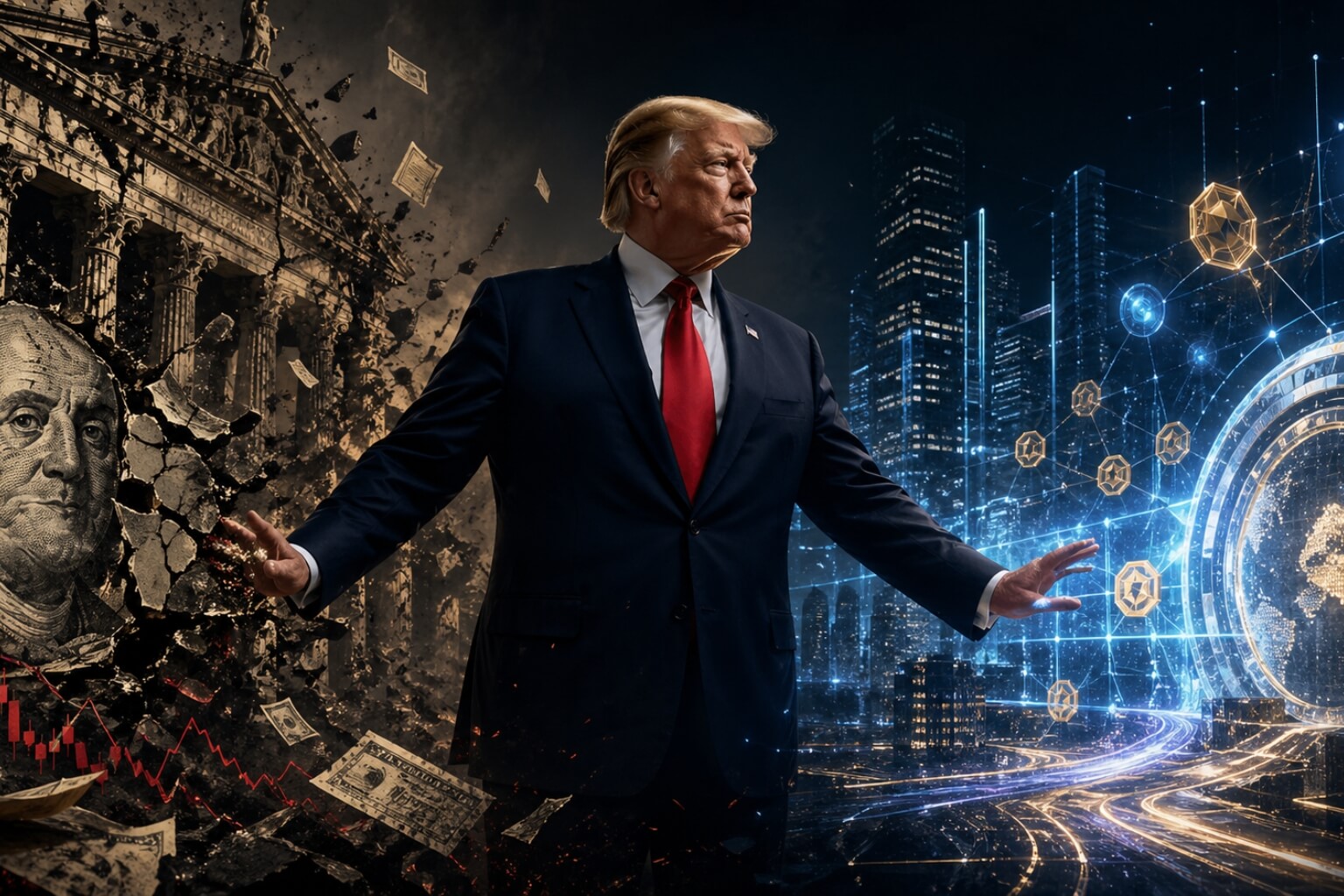
Whether Intentionally or Not, Trump May Bankrupt the U.S. And That Means a New Financial System
That sounds like an extreme sentence.
Maybe even clickbait.
But sometimes the strongest claims describe the direction of the world more accurately than the softer ones.
No, the idea is not that America will wake up tomorrow morning with no money, no army, and no access to markets. The United States is not an ordinary country. It issues the world’s reserve currency, controls the most important debt market on the planet, and still sits at the center of the global financial system. But that does not mean it cannot be pushed toward a point where the model itself begins to crack from within.
And here, the biggest question is not whether Trump literally wants to bankrupt America.
The bigger question is whether his style of governance, trade wars, pressure on institutions, and politics of permanent tension are leading in exactly that direction — toward exhausting the old model so something new can take its place.
America does not break like a company. It breaks like a system
When we talk about the “bankruptcy” of the United States, we are not necessarily talking about a classic bankruptcy. We are not necessarily talking about a moment when the government simply cannot pay tomorrow morning. What we are really talking about is a slower and more dangerous process: erosion of trust, more expensive debt, political unpredictability, pressure on the dollar, and a growing sense that the current system is becoming harder to run, louder, and increasingly dependent on improvisation.
That fear is not abstract. The U.S. fiscal picture is already strained on its own. The deficit is massive. Interest costs are growing. And the more expensive it becomes to carry debt, the more fragile the story starts to look.
That is the key point. It is not just that the debt is huge.
It is that the cost of maintaining it is getting heavier.
And once you add political decisions that increase uncertainty, the damage does not stop at the budget.
It hits confidence.
Trump does not need to want a collapse in order to accelerate one
The most dangerous economic processes rarely begin with an official declaration. They begin with accumulated stress, distorted incentives, and a political mindset that thinks in election cycles instead of decades.
That is exactly why the phrase “intentionally or not” is so powerful.
Because even if we assume Trump does not want to “break” America, his policies and style have already shown that they can create major second-order effects.
Tariffs, institutional pressure, confrontational geopolitics, and a preference for shock over stability can all look strong in the short term. But markets do not reward noise forever. At some point, they begin repricing risk.
And when that happens in the most important economy in the world, the consequences do not stay local.
Markets do not necessarily hate toughness.
They hate chaos.
And when the world’s most important financial power starts to look chaotic, the rest of the world does not just wait and watch. It starts looking for alternatives.
The real risk is not collapse. The real risk is losing the monopoly
America has one enormous advantage that hides many of its mistakes — the dollar.
As long as the world holds reserves in dollars, trades in dollars, finances itself in dollars, and runs to U.S. Treasuries during crises, the United States can afford things no other country can. It can carry more debt. It can refinance more easily. It can export inflation and import trust.
But that advantage is not a law of nature.
The more Washington weaponizes finance, the more political volatility surrounds its economic decisions, and the more unstable the fiscal path becomes, the more the rest of the world has an incentive to slowly build alternatives.
This does not have to look dramatic at first.
In fact, it probably will not.
A new financial system is unlikely to begin with one giant global announcement that everyone has abandoned the dollar. It will likely emerge in pieces. More bilateral trade in local currencies. More regional payment rails. More central bank digital currencies. More geopolitical blocs that no longer want to rely on Washington in the same way they did before.
That is how real transitions usually happen.
Not all at once.
Then suddenly.
The new system will not be “anti-America.” It will be “post-monopoly”
That distinction matters.
People often imagine a new financial order as a sudden victory of one side over another. But the more realistic scenario is not replacement. It is fragmentation of dominance. Not a world without the dollar, but a world with less automatic obedience to it.
And that is a much more believable turning point.
Because the world may not be ready to fully leave the current system.
But it is increasingly motivated to build a backup.
That alone changes the game.
A system does not need to be dead to begin losing control.
It only needs to stop feeling unquestionable.
Where is Trump in all of this?
At the center of it.
Not because he alone created the debt problem. Not because America was a perfectly stable machine until he arrived and hit a red button. The structural problems are older, deeper, and bipartisan.
But Trump does one thing that accelerates everything else:
He increases the volatility of the system.
He likes pressure.
He likes negotiation through shock.
He likes moving the frame aggressively and then seeing who blinks first.
That style can work in politics.
Sometimes it can work in business.
But when you apply it to the world’s reserve currency and the most important bond market on Earth, the side effects become global.
And once long-term confidence begins to weaken, debt becomes heavier, the currency becomes more contested, and institutions begin to look more political than stable.
That is not yet bankruptcy.
But it is a warning.
“Bankruptcy” may even become politically useful
This is the most uncomfortable part.
Sometimes systems are not repaired when they are functioning badly but still functioning. They are repaired when they become noisy enough, unstable enough, and expensive enough that change starts to feel unavoidable.
If America moves into a period of more expensive debt, sharper institutional conflict, more trade disruption, more pressure on the Federal Reserve, and faster development of alternative international payment rails, that will not simply be a crisis.
It will be the justification for a new framework.
More digital.
More trackable.
More centrally manageable.
And marketed as necessary modernization.
That is the point many people miss.
The new financial system is not invented on the day of crisis.
It is prepared long before it.
So if the old model begins to look unstable enough, the political and institutional appetite for a reset will only grow stronger.
Does that mean the end is near?
Not necessarily.
And this is where it is important not to overstate the case. The U.S. economy is still functioning. America still has enormous institutional, military, and financial power. The dollar is still deeply embedded in global trade and reserves. The system is not collapsing tomorrow.
That is exactly why the thesis about a new financial system is more interesting than the purely apocalyptic one.
Because major shifts do not only come from collapse.
They also come from exhaustion.
From the moment when the old system still works, but no longer looks eternal.
From the moment when the world starts preparing for what comes next before the official breakdown ever arrives.
Final thoughts
Trump may not want to bankrupt the United States.
But that is not the most important point.
What matters more is that his style of leadership and his policy instincts may accelerate a process in which America begins to lose its most important asset — unquestioned trust. And once that trust starts cracking, debt gets heavier, the dollar becomes more contested, and the rest of the world starts building emergency exits.
And that is exactly where a new financial system begins.
Not on the day America is “finished.”
But on the day the world decides it can no longer afford to rely only on it.